Hotel Wake-Up Calls: How They Work & Get One
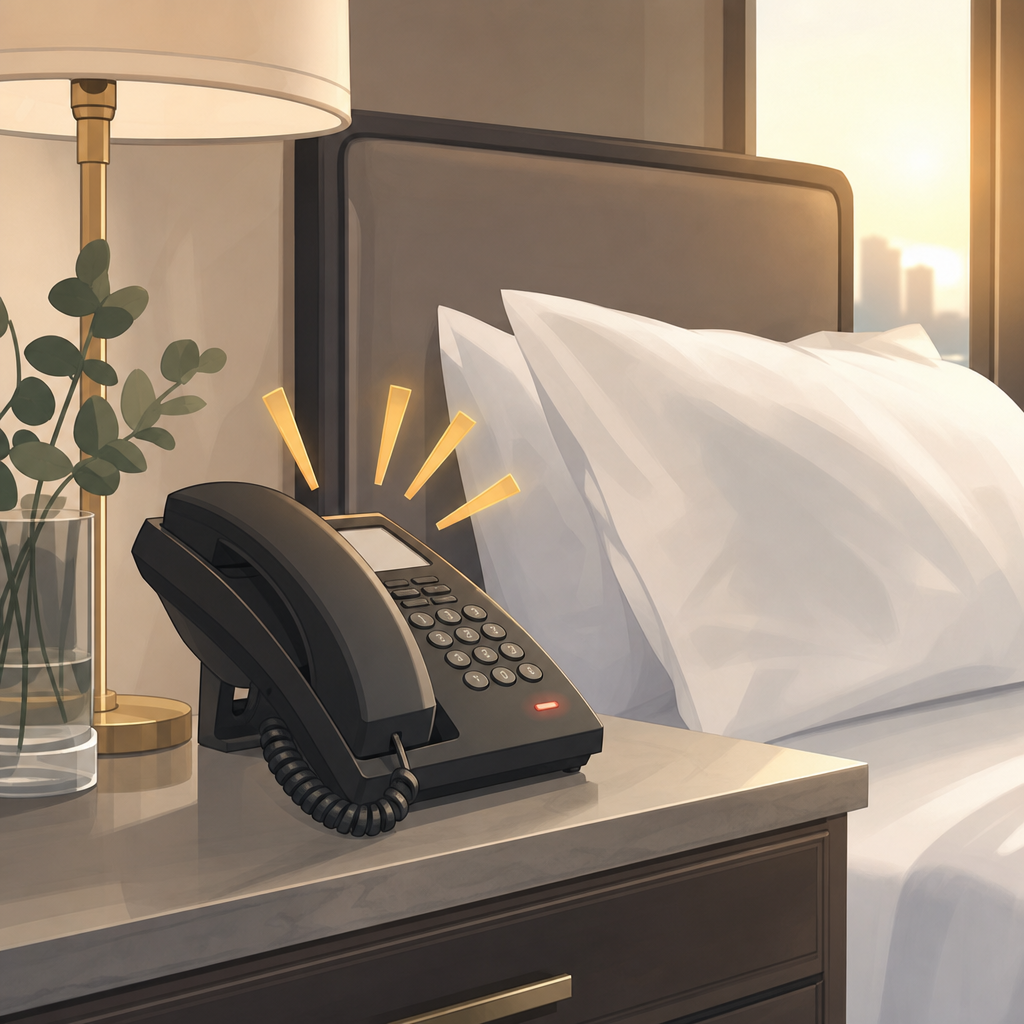
A phone rings, you answer, you're awake. No snooze button, no setup, no willpower required. Here's how hotel wake-up calls actually work in 2026, whether hotels still do them, how to request one, and how to get the same can't-snooze-it call every morning without booking a room.
Quick answer
Do hotels still do wake-up calls? Yes, most hotels with a front desk and in-room phones still offer them, and they're free. The service has quietly faded as smartphones took over, and it's now almost always automated rather than a live person. Some budget and self-service properties have dropped it entirely, so ask at check-in if you're counting on it.
What is a hotel wake-up call? It's a service where the hotel phones your room at a time you choose so you wake up, the telephone version of an alarm clock. In east Asia it's often called a “morning call” and in the UK an “alarm call.”
What a hotel wake-up call is, and how it works today
A hotel wake-up call is a scheduled phone call to your room at a time you request, so you wake up on time. The classic version is simple: you tell the front desk when you want to be woken, and at that time the phone in your room rings. Either a staff member is on the line or, far more commonly now, an automated system plays a recorded greeting.
Behind the scenes, most hotels run wake-up calls through their phone system, the PBX that connects every room. Staff enter your room number and a time, and the system dials your room automatically. In many properties you can also schedule the call yourself by dialling a code on the room phone or using the hotel's app, with no human involved at any point.
A genuinely human wake-up call, a real person greeting you by name, still exists, but mostly at the luxury end. Full-service and high-end hotels treat it as a hospitality touch. At a mid-range or budget property, expect a recording, if the service exists at all.
How to request a hotel wake-up call
If you're staying somewhere tonight and need to be up at a specific time, here's the standard playbook:
- Call or visit the front desk. Dial 0 (or the reception button) from your room phone and ask for a wake-up call at your chosen time. State the time clearly and confirm AM or PM, most wake-up call mishaps are a 12-hour mix-up.
- Check for a self-service option. Many room phones let you schedule the call yourself, look for instructions on or near the phone, often a short dial code. Some hotel apps and in-room tablets offer the same thing.
- Ask what happens if you don't answer. Some systems retry after a few minutes; some send staff to knock; some do nothing. If your flight depends on it, this question matters.
- Set a backup anyway. Front desk staff are human, automated systems fail quietly, and check-in notes get lost. Your phone alarm costs nothing as insurance.
The service is free at essentially every hotel that offers it. It's considered part of basic hospitality, not an extra.
Do hotels still offer wake-up calls, and are they reliable?
Mostly yes, but the service has been quietly fading. As smartphones became universal, demand dropped, and many hotels either automated the service entirely or stopped advertising it. Some budget chains and self-service properties, the ones with no 24-hour front desk, or no room phones at all, have dropped it completely. If it matters to you, ask at check-in rather than assuming.
Wake-up calls haven't disappeared, though. Business travellers, airline crews, conference attendees, and guests with early departures still request them as a second layer of insurance beyond a phone alarm, which is exactly why hotel phone systems still build the feature in.
Reliability is the other honest caveat. A wake-up call is only as dependable as the system and the people behind it. Things that go wrong, in rough order of frequency:
- The time is entered wrong, or AM and PM get swapped
- The request is taken at check-in and never entered into the system
- The automated call rings once, you sleep through it, and nothing retries
- A shift change means nobody follows up when you don't answer
None of this means the hotel wake-up call is bad. When it works, and it usually does, it's one of the best wake-up experiences there is. Which raises an obvious question.
Why a wake-up call beats an alarm
People who travel a lot tend to notice something: they wake up more easily to the hotel phone than to their own alarm at home. There are good reasons for that.
- You can't snooze a phone call. An alarm offers a deal, nine more minutes for one tap. A ringing phone offers a binary choice: answer it or ignore a thing that keeps ringing. Most people answer.
- It feels like a person. Even an automated call carries an implicit “someone is contacting me” signal. Your brain treats an incoming call differently from a sound your own device makes on schedule.
- It's external. You didn't have to configure anything, charge anything, or remember anything. Someone else holds the responsibility, and it just happens to you.
- Answering requires being awake. Picking up a handset and responding is a small cognitive task. By the time you've done it, you're past the hardest part of waking up.
If you regularly sleep through alarms even after a full night, the phone-call effect is worth understanding, we go deep on the mechanics in why you sleep through your alarm. The frustrating part is that the hotel version only exists inside hotels. You check out, fly home, and you're back to a beeping rectangle and your own willpower.
Every way to get a wake-up call, compared
If what you actually want is to be reliably woken by a phone, in a hotel or at home, here are the options side by side:
| Option | How it works | Reliability | Cost |
|---|---|---|---|
| Hotel front desk (live) | Staff call your room at the set time | Depends on the shift; no retry unless you ask | Free for guests |
| Hotel automated system | PBX dials your room, plays a recording | On-time but usually rings once | Free for guests |
| Phone alarm | A tone or song you set yourself | Easy to snooze or sleep through; single point of failure | Free |
| Daily wake-up call service (Reveille) | A real call to your mobile with a spoken briefing; press 1 to confirm; auto-retry | Retries until you confirm you're awake | Free plan; paid from $9.99/mo |
For a full rundown of dedicated apps and call services, see our comparison of every wake-up call service in 2026.
How to get a hotel-style wake-up call at home
This is what Reveille's wake-up call service does. Every morning at your chosen time, Reveille rings your mobile, a real phone call, not a notification, and when you answer, a voice briefs you on the day ahead: today's weather, what's on your calendar, and the morning's headlines. It's the hotel wake-up call, upgraded, and it follows you home.
It also fixes the reliability gaps that hotel systems have:
- Press 1 to confirm you're awake. The call doesn't take “the phone rang” as proof. You confirm you're actually up, on the call itself.
- Automatic retry. If you don't answer or don't confirm, Reveille calls again. No shift change, no forgotten note, no single point of failure.
- A briefing, not a beep. Weather, calendar, and news give your brain something to engage with the moment you wake. You start the day informed instead of just vertical.
- Set and forget. Pick your wake-up time once and the call comes every morning, like clockwork, the no-setup quality that makes the hotel version so good.
There's a free plan if you want to try a daily wake-up call without paying anything, and paid plans start at $9.99 a month for the full briefing experience. Either way, it takes about two minutes to set up.
Common questions
Do hotels still do wake-up calls?
Yes. Most hotels with a staffed front desk and in-room phones still offer wake-up calls, and they remain free for guests. The service is now almost always automated rather than a live person, and some budget or self-service properties have dropped it, so confirm at check-in if you're relying on it.
What is a wake-up call in a hotel?
A wake-up call is a service where the hotel telephones your room at a time you choose so you wake up on time, essentially a phone-based alarm clock. It's known as a “morning call” in parts of Asia and an “alarm call” in the UK.
How do I set a wake-up call at a hotel?
Call the front desk from your room phone (usually by dialling 0) and ask for a wake-up call at your chosen time, confirming AM or PM. Many hotels also let you schedule it yourself via a dial code on the room phone or through the hotel's app. The service is free wherever it's offered.
Are hotel wake-up calls automated?
Usually, yes. Most hotels schedule wake-up calls through their phone system, which dials your room automatically and plays a recorded greeting. A live person on the line is now mostly a luxury-hotel touch. Some budget and self-service properties have dropped the service entirely, so ask at check-in if you're counting on it.
What happens if I don't answer a hotel wake-up call?
It depends on the hotel. Some automated systems retry after a few minutes, some front desks send staff to knock on your door, and some do nothing at all. If your morning depends on it, ask the front desk what their follow-up procedure is, and set a backup alarm regardless.
Can I get a wake-up call at home?
Yes. Reveille calls your mobile every morning at your chosen time with a spoken briefing, weather, calendar, and news. You press 1 to confirm you're awake, and if you don't answer, it calls again. It works anywhere your phone does, no hotel required. There's a free plan, and paid plans start at $9.99 per month.